

Low Sulfite Wine: UK buyers get 30–50 mg/L and a Res Fortes pick
“Low sulphite” describes a wine made with minimal added sulphur dioxide, and no still wine is ever truly sulphite-free. Winemakers who label a bottle “no added sulphites” mean exactly that: nothing was dosed in, though fermentation itself leaves trace amounts behind. Many minimal-intervention producers aim for a total SO₂ of approximately 30 to 50 mg/L, sometimes lower. If you want to try this style, start by asking for a technical sheet or reaching for a small mixed case rather than committing to a full cellar switch.
TL;DR:
- Genuinely low-SO₂ wines typically contain around 10 to 30 mg/L of total sulphites, mainly from fermentation, with minimal additions during production.
- Buying “no added sulphites” is more reliable than selecting “sulphite-free,” and technical sheets help verify actual sulphite levels.
- Low-sulphite wines require careful vineyard and cellar management, such as selective fruit grading and oxygen control, leading to more bottle variation.
- Storage conditions influence stability, as low-SO₂ wines are more sensitive to light, heat, and poor handling, so cool, dark storage is essential.
- Natural wine enthusiasts often prefer curated sources or estate producers like Res Fortes that publish detailed SO₂ data for authenticity and consistency.
What sulphites are and why winemakers use them
Sulphur dioxide has been the winemaker’s insurance policy for centuries. It does two jobs at once, and understanding both helps explain why so few producers abandon it entirely.
Free SO₂ is the active portion still available to work, protecting the wine right now. Total SO₂ is that free portion plus everything already bound to pigments, sugars, and other compounds in the wine. When a technical sheet or label lists a figure in mg/L, it is almost always total SO₂, which is the number regulators care about.
Sulphites earn their place in the cellar through two functions:
- Antioxidant protection. SO₂ slows oxidation, stopping wine turning brown, flat, or sherry-like before its time.
- Antimicrobial control. It suppresses unwanted bacteria and wild yeasts that can spoil a wine or push it towards vinegar.
That dual role explains the “contains sulphites” warning you see on nearly every bottle. In the EU and beyond, that statement kicks in at just 10 mg/L of total SO₂, a threshold so low that almost every wine on the shelf triggers it. The label tells you sulphites are present. It tells you almost nothing about how much.
Is “sulphite-free” wine actually real?
Not in any meaningful sense, and no reputable producer claims otherwise. Fermentation is a biological process, and yeast produces its own SO₂ as a by-product whether the winemaker wants it or not.
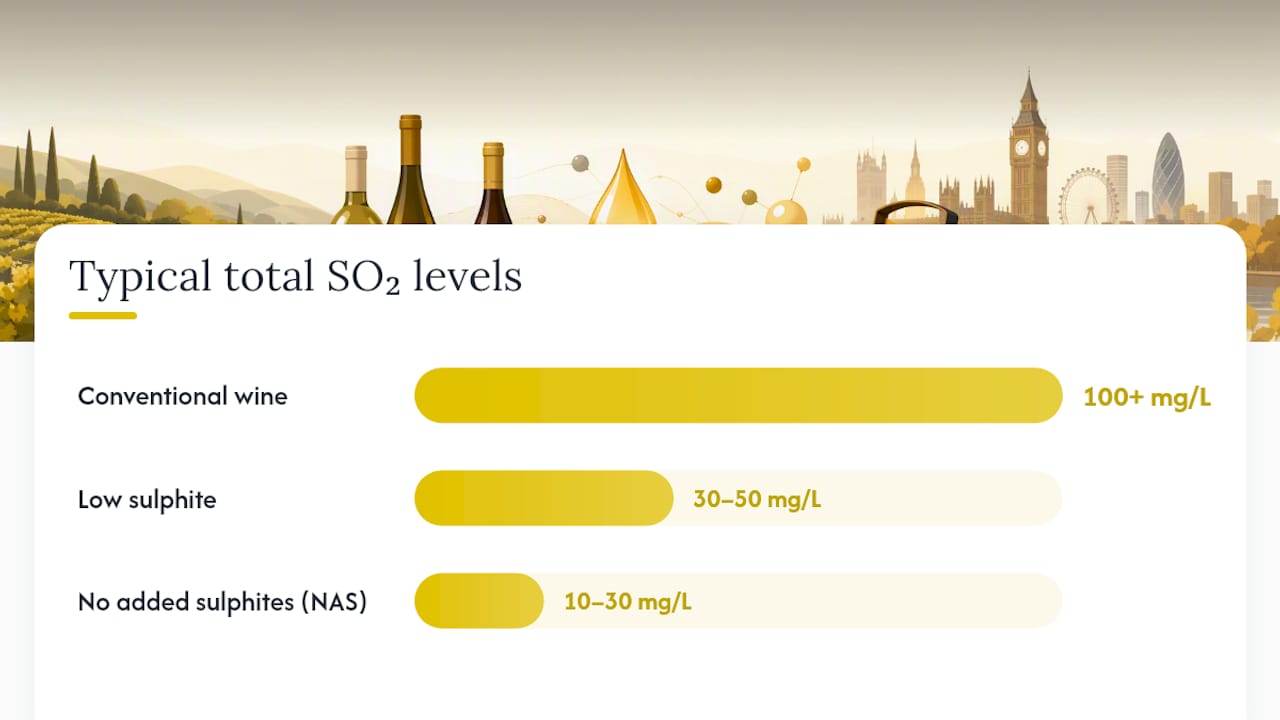
The typical range from fermentation alone runs between about 10 and 40 mg/L. Add nothing further, and you land on what the industry calls “no added sulphites” (NAS), which usually shows a total SO₂ of around 10 to 30 mg/L. Compare that with a conventional supermarket red, which can easily carry 100 mg/L or more, and the gap becomes obvious.
There is no legal definition of “low sulphite” the way there is for “organic,” so the numbers below are informal industry norms rather than statutory limits.
| Term | What it usually means | Typical total SO₂ |
|---|---|---|
| Conventional wine | Sulphites added at multiple stages | commonly 100 mg/L or more |
| Low sulphite | Reduced additions, careful dosing | typically around 30 to 50 mg/L |
| No added sulphites (NAS) | Nothing added; only fermentation SO₂ remains | roughly 10 to 30 mg/L |
Treat “sulphite-free” as marketing shorthand rather than chemistry. The honest, checkable claim is “no added sulphites.”
How low-SO₂ wines are actually made
Cutting sulphites is not simply a matter of leaving a tank alone and hoping. It demands more discipline in the vineyard and cellar, not less.
Producers working towards minimal additions typically rely on:
- Immaculate fruit selection, since rotten or damaged grapes bring in bacteria that SO₂ would otherwise control.
- Native yeast fermentations, letting the vineyard’s own microflora do the work instead of a commercial, more SO₂-tolerant strain.
- Careful oxygen management during ageing, using inert gas and topped-up barrels rather than sulphites to keep air out.
- Precise, minimal dosing decisions at bottling, adding only what the wine’s own chemistry demands rather than a routine dose.
Some winemakers frame the whole exercise as one running question: what is the least SO₂ this wine actually needs to stay stable? That mindset, rather than any single technique, is what separates a genuinely low-intervention producer from one simply printing a fashionable label.
Expect trade-offs. Low-SO₂ wines can show a fine haze, since they are often less aggressively filtered. Aromatics tend to feel brighter and more open, but bottle variation is more common, and no two vintages behave identically. Natural wine can range from polished and classic to distinctly funky, and buyers who taste widely tend to find the style that suits them faster than those who judge from one bottle alone.
Pro Tip: Keep low-sulphite bottles cool and away from light, and once opened, drink within a day or two rather than leaving them on the side. A fridge, even for reds, buys you extra time before oxidation takes hold.
If you are pairing one of these livelier, more expressive bottles with dinner, our guide to a sensory culinary experience is worth a look before you decide what to open.
How to buy low sulphite wine with confidence
Finding a genuinely low-SO₂ bottle takes a little more legwork than grabbing whatever is on the end of the aisle, but the checks are quick once you know them.
- Look for “no added sulphites” on the label, not “sulphite-free.” The former is a specific, checkable claim; the latter is not.
- Ask for the technical sheet. Reputable producers and specialist merchants will happily share the total SO₂ figure in mg/L rather than hiding behind vague language.
- Understand what certification actually promises. EU organic certification permits notably higher SO₂ limits than most minimal-intervention producers use voluntarily, while Demeter’s biodynamic standard sets a stricter cap. Organic on its own is not a guarantee of low sulphites.
- Start with a curated source rather than a single supermarket punt. Specialist natural wine shops and mixed cases let you sample several styles before settling on a favourite.
- Check the vintage and storage conditions where you shop, since low-SO₂ wines are more sensitive to poor handling than heavily sulphured equivalents.
Understanding what is genuinely in the glass helps here too. Our piece on wine character unpacks some of the common misconceptions that sit alongside the sulphite question.
Res Fortes: an example of low-intervention craft in practice
At the foothills of the Pyrenees, in the Côtes du Roussillon, Res Fortes builds its wines around the same principle that drives the best low-SO₂ producers: intervene only where the vineyard demands it, and let old vines and rugged terroir do the rest. Sustainable vineyard management and collaborative, minimal-intervention winemaking sit at the centre of the estate’s approach, not as a marketing flourish but as the working method behind every bottle.
That philosophy has not gone unnoticed. Res Fortes has picked up recognition from the drinks business, Wine Enthusiast, and Fine Vintage, alongside strong ratings from top Vivino reviewers, particularly for the flagship old-vine Grenache expression, The Brave.
For anyone curious about exploring this style without overcommitting:
- The Rosé, with its citrus lift, offers an easy, approachable entry point.
- The Grenache-led GMS blend shows what old vines contribute to texture and restraint.
- The Brave rewards patience for readers already comfortable with expressive, characterful reds.
When is low sulphite wine actually worth choosing?
Here is where I land, having weighed the chemistry against the marketing. If you get genuine headaches or flushing after red wine, a controlled trial of low-SO₂ bottles is worth doing, because most sulphite-blamed symptoms trace back to other compounds or alcohol itself, and testing narrows down the real cause. Anyone with a diagnosed sulphite intolerance, rather than a suspicion, should talk to a doctor before experimenting at all.
For flavour purists and serious collectors, low-SO₂ wine is a genuine trade-off, not a straightforward upgrade. You gain vibrancy and expression; you accept more bottle variation and a shorter shelf life. Buy single bottles or a small mixed case before you decide it is your new house style.
— Moritz
Try low-intervention wine without the guesswork
Rather than hunting through unfamiliar producers hoping their technical sheets check out, Res Fortes gives you a direct, transparent route to minimal-intervention wine from a single, carefully worked estate. Every bottle comes from sustainably farmed old vines in the Côtes du Roussillon, made with the same restraint that defines the best low-SO₂ producers, but backed by awards from the drinks business and Wine Enthusiast rather than a label you have to take on faith.
Curious buyers can start small: order a single bottle, build a mixed case to compare styles side by side, or join the Elite Member programme for early access to limited releases. Orders of three bottles or more ship free to select locations, and checkout runs in multiple currencies. Trade buyers and restaurants after volume should head to the trade and wholesale page to discuss case pricing directly with the team.
Sources
- Low-sulfite Wine 101: What is Low-sulfite Wine? A Guide
- Wine Without Sulfites: The Complete Guide to SO2, Headaches & Low-Intervention
- The 8 best natural wines according to buyers
FAQ
Does Aldi sell sulfite-free wine?
Supermarkets including Aldi occasionally stock “no added sulphites” wines within organic or natural wine ranges, but stock varies by store and season, so checking the label or asking staff for the current range is the reliable approach.
What are the symptoms of sulphite sensitivity in wine?
Reported symptoms include headaches, flushing, and mild breathing difficulty, though most reactions blamed on sulphites are more likely caused by other wine components or alcohol itself, so a medical assessment is the only way to confirm true intolerance.
Where can I buy wine without sulfites?
Specialist natural wine merchants, some supermarket organic ranges, and estate producers such as Res Fortes that publish technical sheets are the most reliable sources, since they will confirm the actual total SO₂ figure rather than relying on vague “sulphite-free” wording.
Which wine is highest in sulphites?
Sweet and dessert wines generally carry the highest SO₂ levels, since sugar-rich wines need extra protection against microbial spoilage, followed by cheaper mass-produced whites and reds that rely on sulphites in place of careful vineyard and cellar practice.